Guide
How to cook dishes that need different oven temperatures
Two dishes, one oven, two temperatures. Here's when a compromise temperature works, when it doesn't, and how to run them one after the other without anything going cold.
An oven holds one temperature. Dishes within a few degrees can share it. Otherwise you have three choices: a compromise temperature for forgiving dishes, one after the other with a planned temperature change, or another appliance — a second oven, the stovetop, an air fryer or a slow cooker.
For a 6:00 PM dinner
Roast potatoes (425°F) and Stuffing (350°F) need the same oven around 5:20 PM at different temperatures.
Checking for a fix…
- 5:00 PM−1:00Preheat oven to 425°FAllow about 15 min
- 5:12 PM−0:48Lower oven to 350°FFrom 425°F · allow 8 min
- 5:15 PM−0:45Roast potatoes into the oven45 min · at 425°F
- 5:20 PM−0:40Stuffing into the oven40 min · at 350°F
- 6:00 PM0:00Roast potatoes out of the ovenStraight to the table
- 6:00 PM0:00Stuffing out of the ovenStraight to the table
- 6:00 PM0:00Dinner is readyEverything should land together
Option 1: a compromise temperature
The advice you'll see most often is to split the difference — bake a 350°F casserole and a 400°F tray of vegetables together at 375°F, and adjust the times. It can work for forgiving dishes: casseroles, gratins, bakes that are mostly about heating through. It works badly for dishes that depend on their temperature: roast potatoes that need a hot oven to crisp, bread and pastry, anything with a precise recipe. The times change too, in ways a recipe won't tell you, so you're relying on checking doneness rather than the clock.
Option 2: one after the other, with a planned change
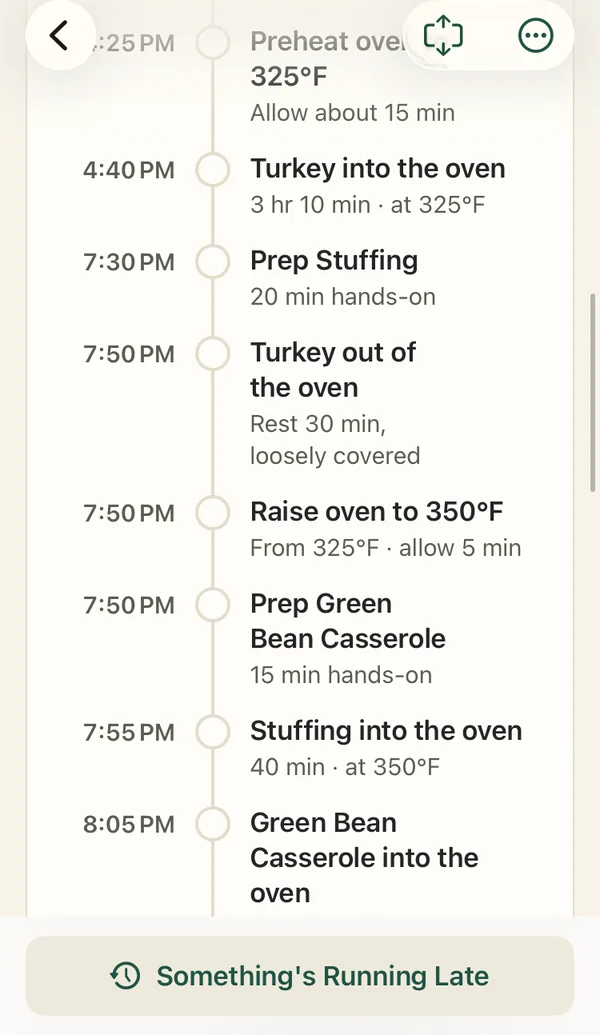
This is what the planner does. It puts each dish at its own temperature, in an order that works, and adds an explicit step to raise or lower the oven between them. The order comes from how long each dish can wait once it's ready: the dish that must go straight to the table gets the slot nearest dinner, and the one that holds well goes first.
Changing temperature isn't instant, so the plan allows for it. Raising the heat takes roughly a minute per 10°F, at least 5 minutes and never more than a full preheat; lowering it means opening the door for a few minutes. These are the allowances the planner uses:
| From | To | Allow |
|---|---|---|
| 325°F | 350°F | 5 min |
| 350°F | 375°F | 5 min |
| 350°F | 400°F | 5 min |
| 325°F | 425°F | 10 min |
| 300°F | 450°F | 15 min |
| 425°F | 350°F | 8 min |
An example that doesn't fit at first
Roast potatoes (425°F, 45 minutes, serve within 15 minutes) and stuffing (350°F, 40 minutes, holds for 30) for a 6:00 dinner. The potatoes need the last 45 minutes at 425°F, so the stuffing has to finish before them — and the oven needs time to climb from 350°F to 425°F in between. As first planned it clashes: Roast Potatoes (425°F) and Stuffing (350°F) need the same oven around 5:20 PM at different temperatures. The fix the planner finds: Start Stuffing 53 min earlier and keep warm until dinner. The stuffing waits a little beyond its usual window, covered, which is inside the limit the planner allows. That's the default in the tool above — press Use this fix to see it.
Worked example
Stuffing, then roast potatoes, dinner at 6:00 PM
- Dinner
- 6:00 PM
- First step
- 4:07 PM
- Cooking day
- 1 hr 53 min
- Oven changes
- 1
- 4:07 PM−1:53Prep Stuffing20 min hands-on
- 4:12 PM−1:48Preheat oven to 350°FAllow about 15 min
- 4:27 PM−1:33Stuffing into the oven40 min · at 350°F · time set by you
- 5:00 PM−1:00Prep Roast Potatoes15 min hands-on
- 5:07 PM−0:53Stuffing out of the ovenKeep warm until dinner
- 5:07 PM−0:53Raise oven to 425°FFrom 350°F · allow 8 min
- 5:15 PM−0:45Roast Potatoes into the oven45 min · at 425°F
- 6:00 PM0:00Roast Potatoes out of the ovenStraight to the table
- 6:00 PM0:00Dinner is readyEverything should land together
Option 3: use something that isn't the oven
A second oven removes the problem: the same two dishes each get their own oven and finish together, and the first step moves to 4:45 PM. Without one, move whatever you can: vegetables and sauces to the stovetop, mashed potatoes or a side kept warm in a slow cooker, a small tray of something crisp to an air fryer. Add them under Your kitchen in the planner and change the dish's equipment.
Big roasts help too. A turkey or rib roast rests for 20–30 minutes out of the oven — the one time in a holiday meal when the oven is free and can go to a new temperature. The one-oven Thanksgiving guide is built around that window.
Questions people ask
Can I bake two things at different temperatures at the same time?
Only by picking one temperature for both. That can work for forgiving dishes like casseroles if you check doneness; for crisp roast potatoes, bread and pastry, cook them one after the other or use another appliance.
Which dish should go in the oven first?
The one that can wait. Casseroles, stuffing and braises hold well and go first; rolls, Yorkshire puddings and roast potatoes are best straight from the oven and go last.
How long does an oven take to change temperature?
It depends on the oven. The planner allows about a minute per 10°F when raising the heat — at least 5 minutes and no more than a full preheat. An oven thermometer shows how yours behaves.
Holiday Dinner Planner for iPhone
The oven change, as a reminder.
“Raise oven to 425°F” arrives on your phone when it's due, and the next step is always on your Lock Screen.
- A reminder for every step. Preheat, in, out, rest — each one arrives on time, even with the phone locked.
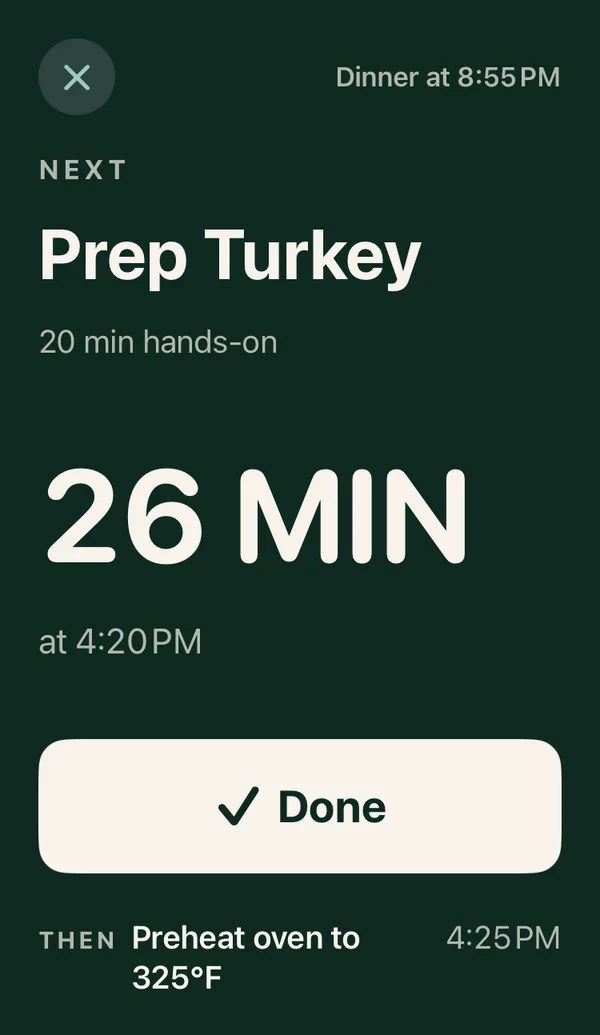
- Cook Mode. The next step in huge type you can read across the kitchen. The screen stays awake.
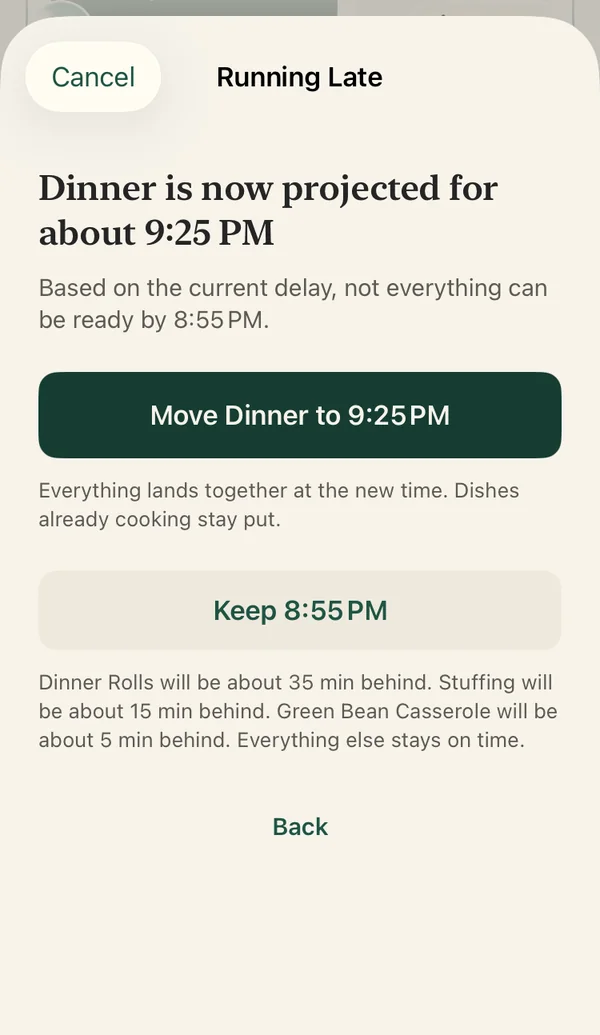
- Running late? It replans. Tell it the turkey needs 15 more minutes. Only the steps that depend on it move.
- Next year is already done. Every dinner is saved. Use it again and the dishes, kitchen and guests come along.
Free for one dinner with up to three dishes. Pro is a one-time purchase, not a subscription. No account, no ads, no tracking.